Governance insight

The decision cannot wait for the next meeting.
The workspace chair exercises their delegated authority, makes the call, and issues a Chair's Action — notifying the relevant members that a decision has been made on their behalf.

Three respond. Five do not.

Chair's Action is the mechanism used when a decision genuinely cannot wait for the next scheduled meeting. It applies wherever someone holds delegated authority over a workspace — the board chair, the head, a committee chair, a head of department. Whoever calls it, the principle is the same: a decision is made, the relevant people are notified, and formal ratification happens at the next meeting.

A note on terminology. In some jurisdictions — particularly English maintained schools — "Chair's Action" has a specific legal definition at governing body level, with authority established through school governance regulations. Academy trusts need equivalent authority set out in their articles or scheme of delegation. In international and independent schools the term is used as borrowed governance good practice, without a specific statutory basis. Loom applies it across all workspace types — board, committee, leadership team, department — to mean the same underlying principle: a decision made within delegated authority, between meetings, that is recorded, notified to the relevant members, and returned to the group for acknowledgement at the next meeting. The governance obligation is the same whatever the local terminology.

The mechanism is legitimate and necessary. The problem is what it usually travels on: an email thread. Email notifies — but it cannot tell you who opened it, who considered it, or whether the silence of five members means agreement, absence, or a concern that did not quite reach the reply button. The question is not whether the decision was right. It is whether anyone actually received it — and whether the communication channel gives the chair any useful signal before ratification.

  • Which members have seen the decision — and which have not
  • Whether the silence of five members represents agreement, absence, or an unvoiced concern
  • Whether ratification at the next meeting reflects genuine engagement or simply the absence of objection
  • Where this decision sits in the governance record three years from now, when the chair and several members have changed
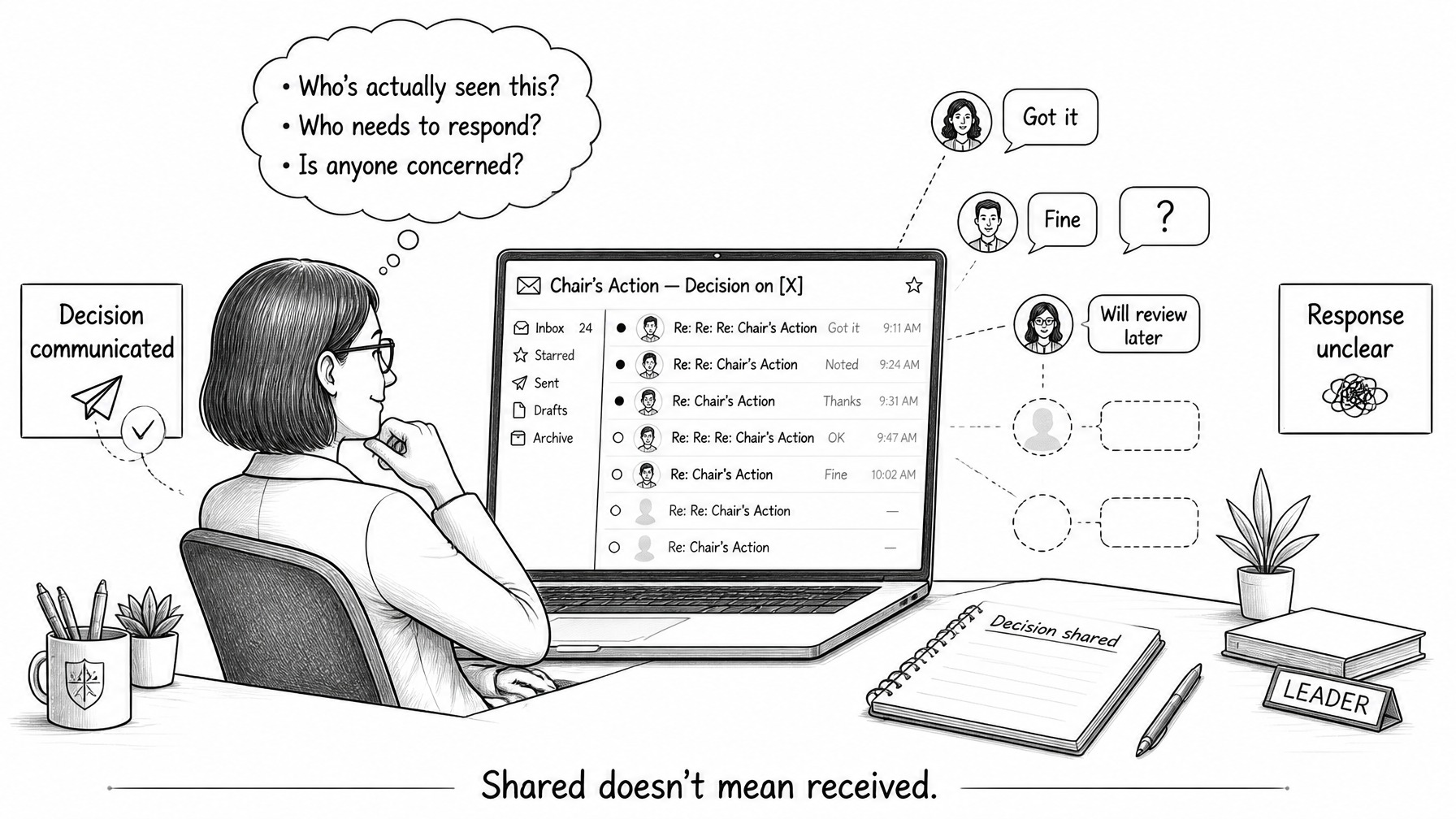
The gap between sharing a decision and knowing it was received.

Shared. Noted. Ratified.
Did anyone actually receive it?

Silence cannot be read as agreement.
But it usually is.

When five of eight governors do not respond to a Chair's Action email, the chair is left to interpret the silence. In practice, non-response is usually treated as implicit consent. The decision record notes: circulated, no objections received.

But silence does not distinguish between a governor who read it, considered it, and agreed - and a governor who did not open the email at all. Or one who had a concern and assumed someone else would raise it. Or one who was away and meant to reply later.

The ratification question at the next meeting - "any concerns?" - lands without the chair knowing who is in a position to have concerns. That is not governance. It is a formality that looks like governance.

Where Chair's Action lives today
The email thread - in the chair's sent folder, the clerk's inbox, and wherever the governors who replied chose to keep it. Not one of those inboxes is the governance record.
Where Chair's Action should live
In the governance record - alongside meeting decisions, policies, and board pack items - traceable by any future governor, clerk, or chair, regardless of who held those roles at the time.

Chair's Action decisions often have ongoing implications: emergency exclusion arrangements, financial commitments, safeguarding escalations. The record cannot depend on whether a former chair's inbox still exists.

Email-based circulation vs structured acknowledgement

The difference is not about adding steps - it is about getting a different quality of information before the meeting starts. With structured acknowledgement, the chair arrives at ratification knowing whether the board has engaged, and whether any item needs agenda time.

Email-based circulation

1
Chair's Action sent by email
To: all governors
2
Some governors reply
Others do not - reason unknown
3
Non-response treated as consent
Record sits in inboxes
4
Ratification: "Any concerns?"
Silence. Noted.

Structured acknowledgement

1
Chair's Action issued in governance record
Governors notified with a signal prompt
2
Each governor signals explicitly
Acknowledged - or - Flag for discussion
3
Chair sees engagement before the meeting
Items flagged surface to the agenda automatically
4
Ratification with clarity
Record persists in the governance log

Acknowledged does not mean agreed.
Silence does not mean consensus.

The purpose of ratification is to confirm the board was properly informed and had a genuine opportunity to raise concerns. That purpose is undermined if the chair does not know, going into the meeting, who engaged with the decision at all. Explicit signals resolve this - not by adding bureaucracy, but by replacing an assumption with a fact.

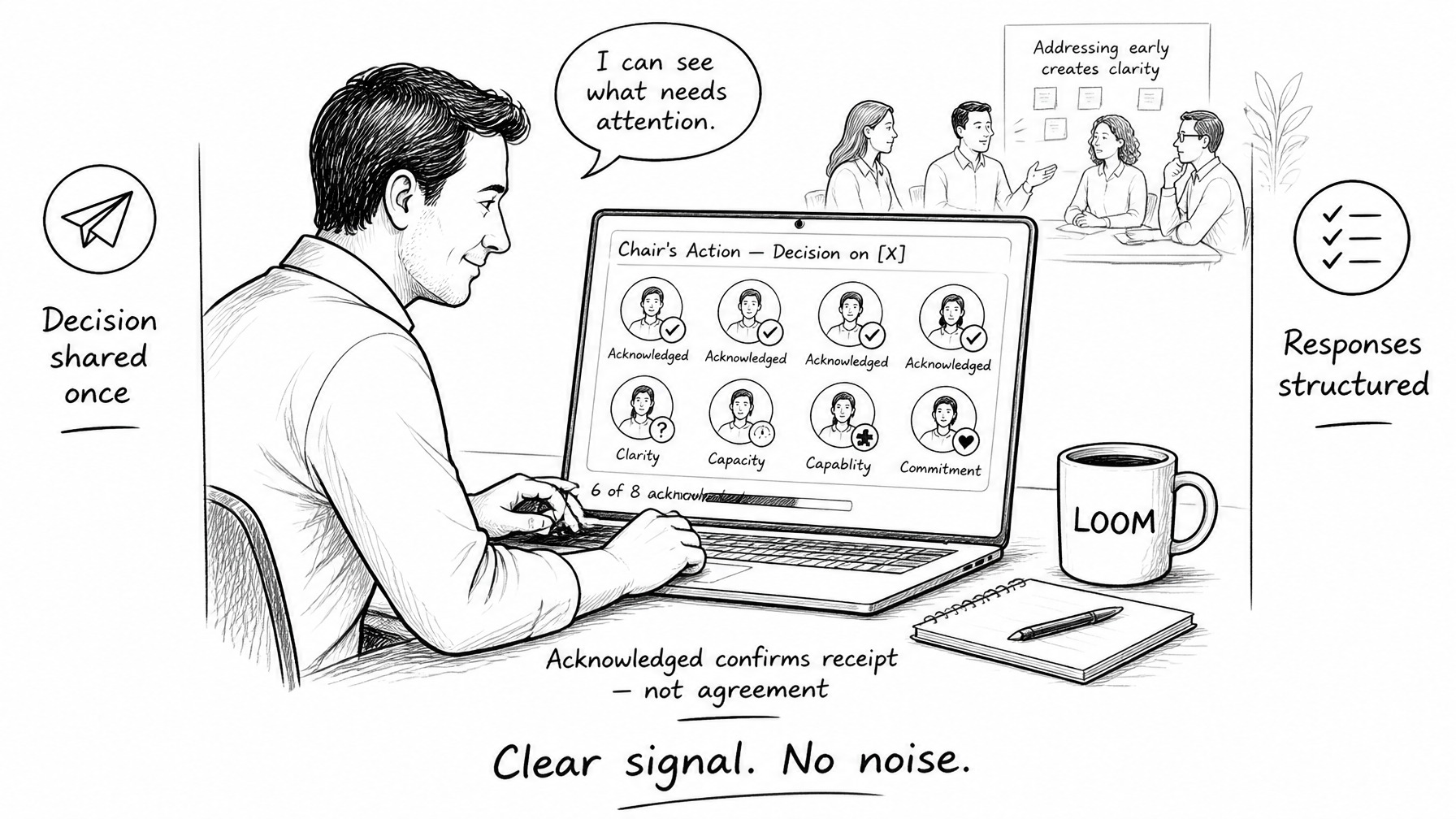
A workspace chair at his laptop looks at a Loom screen showing eight member avatars. Four show Acknowledged with checkmarks. Four others are labelled Clarity, Capacity, Capability, Commitment. The progress indicator reads 6 of 8 acknowledged. He says: I can see what needs attention. In the background, a focused meeting is under way. Labels: Decision shared once, Responses structured. Caption: Acknowledged confirms receipt — not agreement. Clear signal. No noise.

The workspace chair sees who has acknowledged and who has not — before the meeting, not during ratification. Structured responses replace inbox noise.

Two signals. Binary. Deliberate.

The signals are intentionally minimal. A governor is not asked to agree or disagree with the Chair's Action - that is not the purpose of circulation. They are asked to indicate one of two things: that they have seen and accepted the decision, or that they want it discussed before ratification. Either signal is a genuine act of governance engagement. Silence is not.

Acknowledged

Seen, understood, and accepted

The governor has read the Chair's Action, understands the decision that was made, and has no concern that requires agenda time. This is the expected outcome for the majority of Chair's Actions.

The chair can see which governors have acknowledged, and when. The record is specific and complete - not a count of email replies.

Recorded in the governance log - with governor name and timestamp

Flag for discussion

A concern that needs agenda time

The governor has read the Chair's Action and has a concern - about the decision itself, the scope of delegated authority, or whether it should have waited for a full meeting. They are signalling that ratification needs genuine discussion, not a formality.

When a governor flags for discussion, the item surfaces to the meeting agenda automatically - before ratification, with time to address it properly.

Surfaces to the meeting agenda before ratification - not as a surprise at it

Four questions. Before the ratification agenda item.

With structured acknowledgement, these questions are answerable by the workspace chair before the meeting starts — not at the moment ratification is called. If they cannot be answered without reconstructing email threads, the Chair's Action record is incomplete.

Question 1

Which governors have acknowledged this Chair's Action - and which have not yet responded?

Question 2

Has anyone flagged this for discussion before ratification - and if so, who and why?

Question 3

When was this decision made, by whom, under what delegated authority, and who was informed?

Question 4

Where does this Chair's Action sit in the governance record - traceable by a future governor or clerk?

The standard to aim for
Ratification should be a confirmation that the board was genuinely informed and engaged - not a procedural item that assumes engagement happened because no one objected. If the chair cannot answer these questions before the meeting, the ratification is not doing what ratification is for.

Where email-based Chair's Action fails quietly

Most boards do not feel that their Chair's Action process is broken. The decisions get made, the clerk notes them, ratification passes without incident. The failure is subtle and accumulates:

  • The chair cannot distinguish between governors who engaged and those who did not see the email
  • Ratification becomes a formality rather than a genuine governance act
  • Concerns that were not quite urgent enough to prompt a reply-all never surface
  • The record of Chair's Actions is distributed across personal inboxes, not held in one place
  • When governors, clerks, or chairs change, that record becomes inaccessible or lost
  • Repeated informal ratification erodes the board's collective sense of what was actually agreed

The question is not whether the current process is producing bad decisions. It is whether the board can actually verify that Chair's Action decisions were properly communicated, genuinely considered, and correctly ratified - at any point in the future.

Loom is built for this

In Loom, Chair's Action is a first-class governance record - not an email thread. It is issued, circulated, and acknowledged within the governance platform, and it persists in the governance log alongside meeting decisions and board pack items.

  • Each governor signals their response explicitly: acknowledged or flag for discussion
  • The chair sees a live engagement view - who has responded and who has not
  • Items flagged for discussion surface automatically to the meeting agenda
  • The record includes who was notified, when they responded, and what signal they gave
  • The full Chair's Action history is traceable by any future governor or clerk, regardless of turnover

Not more process. The same process - with a record that actually holds.

Board Deck Standard 3.1: Ethical Governance and Leadership ↗

Think about your last Chair's Action

Without searching through email, can the workspace chair answer these right now?

You can name which governors acknowledged the last Chair's Action - and which did not respond - without checking email threads.

The decision record for any Chair's Action from the last three years is accessible to a governor who joined the board this term.

Your ratification process would surface a governor's concern before the agenda item - not rely on them raising it in the room.

If any of those requires a search through email, the Chair's Action record is not in the governance log - it is in someone's inbox. That is not a documentation problem. It is a continuity problem: one that compounds quietly with every governor, clerk, and chair who leaves the board.
SYNNOVATELeadership FrameworksDECKSLeadership PracticeLOOMOrganisational Infrastructure

Synnovate connects leadership frameworks, leadership practice, and organisational infrastructure.

LOOM provides the infrastructure that captures signals from real work and reveals patterns across the organisation.

Explore Loom → loom.education