1
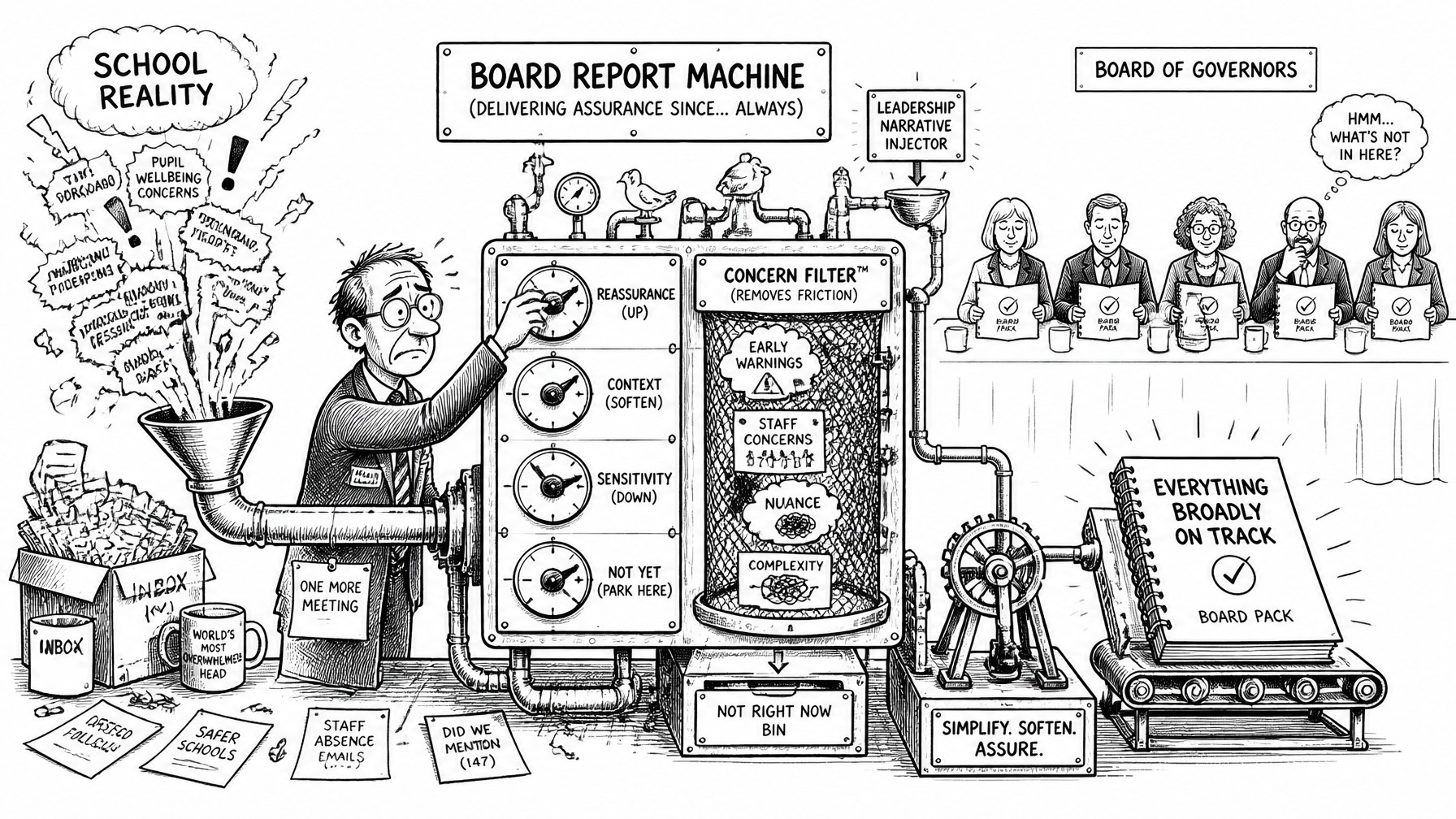
Reporting becomes more polished and less specific
Narrative replaces data. Challenges are described as managed. Risks appear as categories rather than particulars. Updates confirm the direction without naming the difficulties.
There's a question most governing boards never directly ask themselves. Not because it's too sensitive. But because it hasn't yet occurred to them.
Is your board designed to know, or only positioned to be told?
These aren't the same thing. Understanding the difference is the first step toward governance that can actually see what it governs.
Positioned to be told
The right people are in the room. The right documents are circulated. The right meetings are held. The governance machinery is operating.
Designed to know
The board has structural access to institutional reality that doesn't depend entirely on who chooses to disclose it, and when.
The gap between governance process and governance visibility
The comfortable illusion
Consider how a well-run board meeting feels. The board pack arrives in advance. The head presents clearly. Questions are asked and answered. Concerns are noted. Actions are agreed. Minutes are taken.
This produces all the visible signals of good governance. What it doesn't automatically produce is an accurate picture of the institution.
The board pack isn't the institution. It's a representation of the institution, produced by the people who run it, for the people who govern it.
Warning signs
Governance visibility typically erodes gradually, or was never fully built in. These patterns are not conclusive individually — but significant in combination.
Narrative replaces data. Challenges are described as managed. Risks appear as categories rather than particulars. Updates confirm the direction without naming the difficulties.
Conversations feel smooth. Questions land well. There's less of the productive friction that comes from genuine complexity being worked through in the room.
The board receives turnover statistics. It doesn't receive turnover stories: what people said as they left, what they declined to say, what they said to each other that nobody said upward.
One disclosure becomes the conclusion of a governance thread rather than its opening. The board has been told. It doesn't know whether it's been informed.
The head brings solutions. The board hasn't been present for the problem. This can be efficient — it can also mean the board's understanding of institutional reality has a systematic delay, the gap between when difficulty begins and when it becomes safe to surface.
The harder thing to say
When disclosed problems consistently produce visible loss of confidence, anxiety that destabilises rather than resolves, or pressure that lands on the head rather than on the problem — leaders learn, correctly, that bad news has a cost.
The lesson becomes: bring solved problems, not emerging ones.
Which means the board sees reality late. Sometimes too late to govern it.
Boards that want to receive honest information need to be observable as safe to be honest with. Not uncritical. Not passive. But demonstrably able to receive difficulty without becoming the next difficulty that has to be managed.
That's a governance culture. Cultures aren't produced by stating them in governance handbooks. They're produced by what actually happens when someone tests them.
Independent visibility isn't a board gathering informal intelligence by bypassing the head. That route produces something worse: governance instability, staff caught between competing authorities, and an organisation that has learned to operate politically.
Independent visibility means something more specific: the board's picture of institutional reality doesn't rest entirely on voluntary executive disclosure.
That principle can be implemented without undermining leadership.
In practice
The board governs the design of visibility. Leadership still owns the work. None of these expresses distrust in the current head — they're expressions of good design.
The board receives findings directly, before the management response has framed them.
Shared with the governance committee as aggregated patterns, alongside leadership's analysis and proposed response. The board sees the signal, the method, and the leadership response — not individual survey comments or staff-facing interventions.
The designated safeguarding lead reports against agreed thresholds to the safeguarding governor or relevant committee. The board knows whether safeguarding systems are functioning — it doesn't become an alternative operational channel except through clearly defined routes.
With the business manager, the SENCO, or school counsellor — built into the governance calendar as normal practice, not triggered by suspicion. Governors listen for patterns relevant to board oversight, not instructions or operational problem-solving.
Not "the head decides when the board needs to know" — but "when these indicators are reached, disclosure is automatic."
For legal disputes, conflict of interest declarations, and employment actions — treated as standing assurance items, not event-triggered disclosures. These areas require particular care: the board needs to know enough to govern without receiving detail that is operationally sensitive, legally privileged, or confidential to individual staff. The design question is what form of assurance reaches board level, not whether every detail does.
The governance maturity test
If the head wanted to manage a significant emerging risk privately — not out of dishonesty, but from confidence they could resolve it before it needed escalating — what would stop the board from missing it entirely?
What would we not know, if the head chose not to tell us?
How would we know if staff morale was declining — not from the head's reading of it, but from the organisation itself?
When a legal or employment matter surfaces in our meetings, is that the beginning of our involvement, or closer to the end?
Do we ever hear about problems that were resolved before they reached us — and if so, when did we last ask what those problems were?
Is our board the kind of board that a head would bring genuinely difficult information to early?
The design ambition
The goal isn't a board that positions itself as an adversary of its own leadership, or that treats governance as an exercise in surveillance.
The goal is an institution where reality can move upward before crisis forces it upward.
That requires governance design, not just governance compliance. Most schools aren't yet designed this way. Most can be.
Loom is the Synnovate platform that specialises in school governance — connecting board decisions, leadership actions, and institutional memory across the full governance cycle.
Governance resources like this one live at loom.education because that's where the tools are. Synnovate also runs governance workshops that help boards examine the design of their own visibility — what they would and wouldn't know, and what structural changes could close the gap.
Board Deck Standard 5.1: Monitoring and Evaluation of Strategic Goals ↗The mechanism and the institution it serves, in one place.