Governance Resource
The Governance Instinct You Don't Know You Have
Most governance development addresses what trustees know. The harder question is how they respond under pressure - and that gap is rarely visible until you look for it deliberately.
A trustee with twenty years of HR leadership sits on a school board. She can see the head is stretched - the workload is relentless, the senior appointment process is behind, and nobody has time to give it proper attention. She offers to help shortlist candidates. The head, reluctantly, agrees.
She has the expertise. She cares about the school. Senior appointments clearly matter. From the inside, it looks like competence and generosity: a capable professional offering what she knows to an institution she serves.
It's also one of the most common ways capable trustees cross a governance boundary without noticing.
Not because the intention is wrong. Because the instinct that made someone effective in one professional setting doesn't always transfer cleanly into governance.
In a professional role, expertise often means moving towards the problem. Ask better questions. Get closer to the detail. Help resolve the issue.
In governance, the task is different. Trustees aren't there to replace executive judgement with their own. They're there to hold the frame: purpose, accountability, assurance, risk, decision quality, and long-term stewardship.
That distinction is easy to explain. It's much harder to practise under pressure.
The Confidence Problem
Many boards don't begin with a felt need for governance development.
The people around the table are often experienced, thoughtful, and professionally successful. They've led organisations, managed budgets, handled legal questions, chaired committees, built teams, negotiated crises, and made difficult decisions.
So governance can feel familiar.
A finance director knows how to read numbers. A lawyer knows how to read risk. A former head knows how schools work. A senior executive knows how decisions get made. Each person brings something valuable.
But each person also brings a reflex.
The finance director may move quickly towards assurance. The former head may interpret the issue through operational experience. The lawyer may see exposure before culture. The executive may look for a decision before the board has understood what the issue is really signalling.
None of that is a flaw. It's human. It's also exactly where governance can drift.
The problem isn't that trustees lack intelligence or care. The problem is that professional confidence can arrive before governance calibration.
And because the boardroom is usually polite, structured, and time-limited, those instincts often remain invisible. The board discusses the issue, reaches a decision, and moves on. What remains unseen is how the conversation was shaped before the decision was made.
Who moved towards the problem? Who held the boundary? Who sought closure quickly? Who stayed with the uncertainty? Who deferred because the chair seemed ready to move on? Who saw a wider signal that others treated as an isolated matter?
These aren't questions most boards ask. Yet they shape governance more than many boards realise.
Why Instinct Matters
Governance is often discussed as if it were mainly a matter of knowledge.
Know your role. Know the difference between governance and management. Know the committee structure. Know the policy cycle. Know the legal duties.
All of that matters.
But knowledge isn't the same as instinct.
Instinct is what appears before reflection has time to catch up. It shows up when a parent corners you at a school event. When a safeguarding concern appears in the head's report. When a risk register item hasn't changed for three meetings. When the chair closes an item before others have spoken. When a staff member approaches you privately after a board meeting.
In those moments, trustees don't respond from a handbook. They respond from habit, experience, identity, and pressure.
That's why a board can understand governance in principle and still behave differently in practice.
What Becomes Visible
Imagine a board of eight trustees responding to the same set of short governance scenarios.
Not by selecting the "right" answer. Not by rating themselves against a standard. But by placing their response on a field that shows where their instinct sits in the moment.
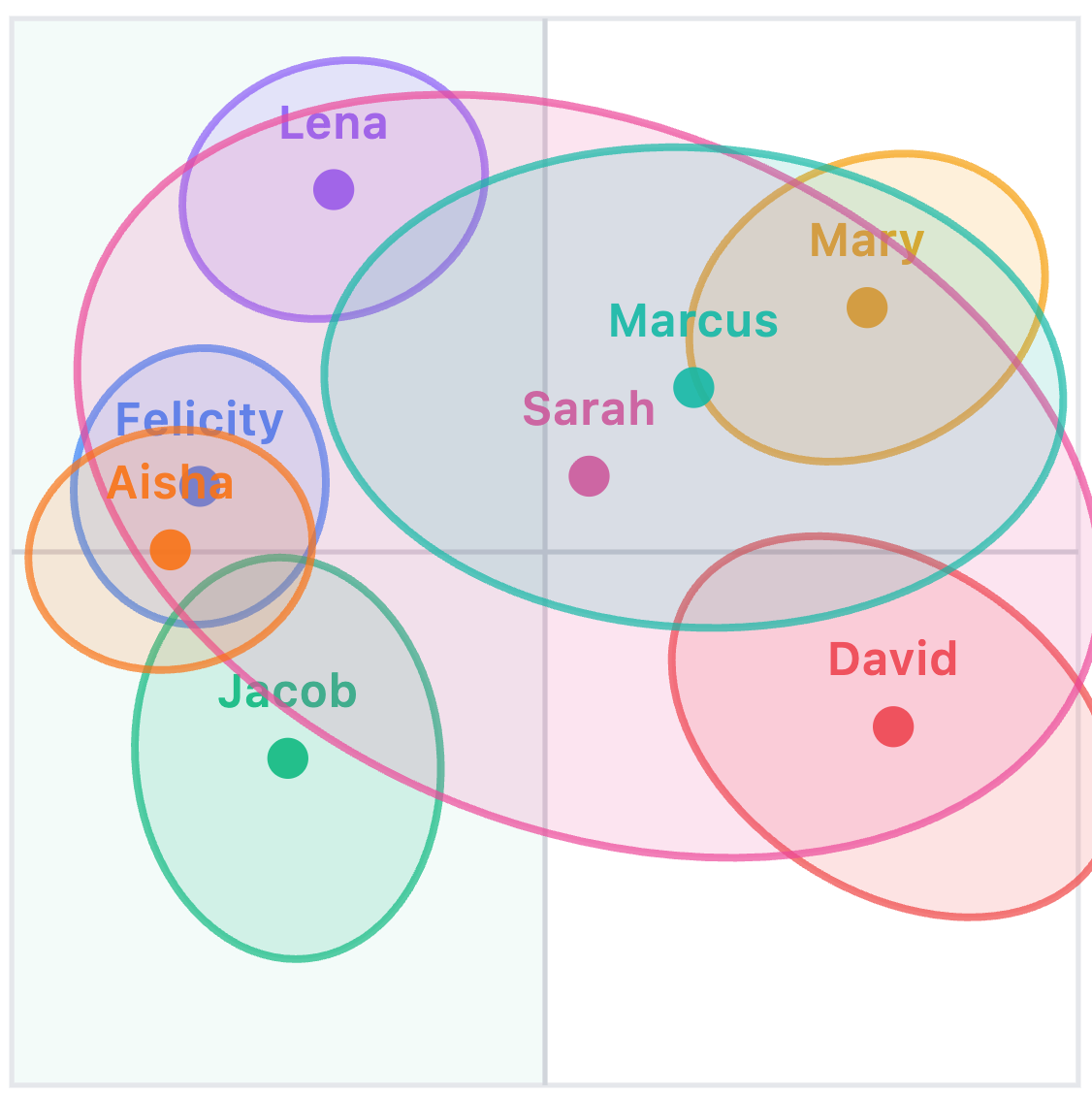
Each shape represents one trustee's instinct pattern. The spread tells you as much as the position.
When those patterns are seen together, a different kind of conversation becomes possible.
The chair may discover that her instinct sits noticeably apart from the rest of the board's.
The finance committee may see that its members cluster tightly in one part of the field, which helps explain why some agenda items feel clear and efficient while others keep circling.
A trustee who sees himself as cautious may notice that, under pressure, he moves towards intervention more often than he expected.
A board that believes it's aligned may discover that alignment exists in decisions, but not in instinct.
That distinction matters.
Boards often know what they decided. They rarely see how their collective reflexes shaped the decision.
The Productive Discomfort
The aim isn't to tell trustees they're wrong.
That rarely works. It can easily sound patronising, especially to capable people who already give time, expertise, and care to the school.
The more useful move is to make a pattern visible.
A visible pattern creates a different kind of discomfort. It doesn't accuse. It invites recognition.
"I can see why I placed myself there."
"I hadn't realised I did that so consistently."
"That explains why this kind of issue feels difficult for us."
"That may be why the board waits for the chair before speaking."
This is the point at which governance development becomes wanted rather than imposed. Not because someone has told the board it needs training. Because the board has seen something about itself that it can't quite unsee.
That's the gap worth working with: the space between how trustees understand their governance role and how they instinctively respond when the room becomes more complicated.
If this describes a conversation your board hasn't had - about how it actually functions under pressure, not just what it decides - the Governance Instinct Diagnostic is a place to start.
Start the diagnostic →Individual diagnostic is free and takes about 10 minutes. Setting up a board session takes about 30 seconds - register with an email address so you can access the results later.